
Concealed rear-face stone panel fixing
Rear Undercut Stone Anchors
Rear undercut stone anchors are stainless steel fixing components for concealed attachment at the rear face of stone panels. WISINE can review back-bolt style anchor configurations by anchor type, stone-panel geometry, bracket or rail interface, material, finish and project drawings.
- RFQ review for rear undercut anchors, back-bolt fixing hardware and matched assembly components.
- Stone-panel inputs may include thickness, edge distance, undercut-hole geometry and remaining wall thickness where applicable.
- Drawing-based review can coordinate anchor body, thread, washer, spacer, bracket interface and setting method.

Product and RFQ scope
Rear Undercut Stone Anchor Overview
This page supports sourcing and RFQ preparation for concealed rear-face stone-panel anchor hardware. It focuses on rear undercut stone anchors and back-bolt fixing components, not general stone anchors or a complete facade fixing design.
Product-Family Boundary
The selected product configuration controls the anchor body, engagement feature, thread, washer, spacer and bracket-interface details. A rear undercut anchor should be reviewed as one component within the complete stone-panel fixing assembly.
RFQ Boundary
Final geometry should follow the selected product specification and project drawings. This page does not provide structural design, load calculation or product-specific installation instructions.
Assembly relationship
How Rear Undercut Anchors Fit the Stone Fixing Assembly
Rear undercut anchors may connect the rear face of a stone panel to bracket, rail or project-specific connector hardware. The undercut anchor is one component within the stone-panel fixing assembly. Bracket, rail, connection and structural requirements should be coordinated through the project drawings and responsible engineering review.
Stone Panel Rear Face
The panel input should identify stone type, panel thickness, panel dimensions, anchor location, edge distance and rear-face clearance conditions.
Anchor and Hardware Stack
The RFQ may include anchor or back-bolt type, engagement component where confirmed, nut, washer, spacer and the bracket connection interface.
Support Interface
Bracket, rail, adjustment component and custom connector details should be supplied from project drawings when the anchor must coordinate with a larger fixing assembly.
Configuration review
Anchor Components and Product Configurations
Rear undercut stone anchors may use different product-specific configurations rather than a single universal assembly. The actual anchor body, sleeve, cone, engagement component, thread, hole geometry and setting method should follow the selected product configuration and project drawings.
Rear undercut stone anchors should not be treated as generic expansion bolts. Component terminology and setting details depend on the selected anchor configuration.
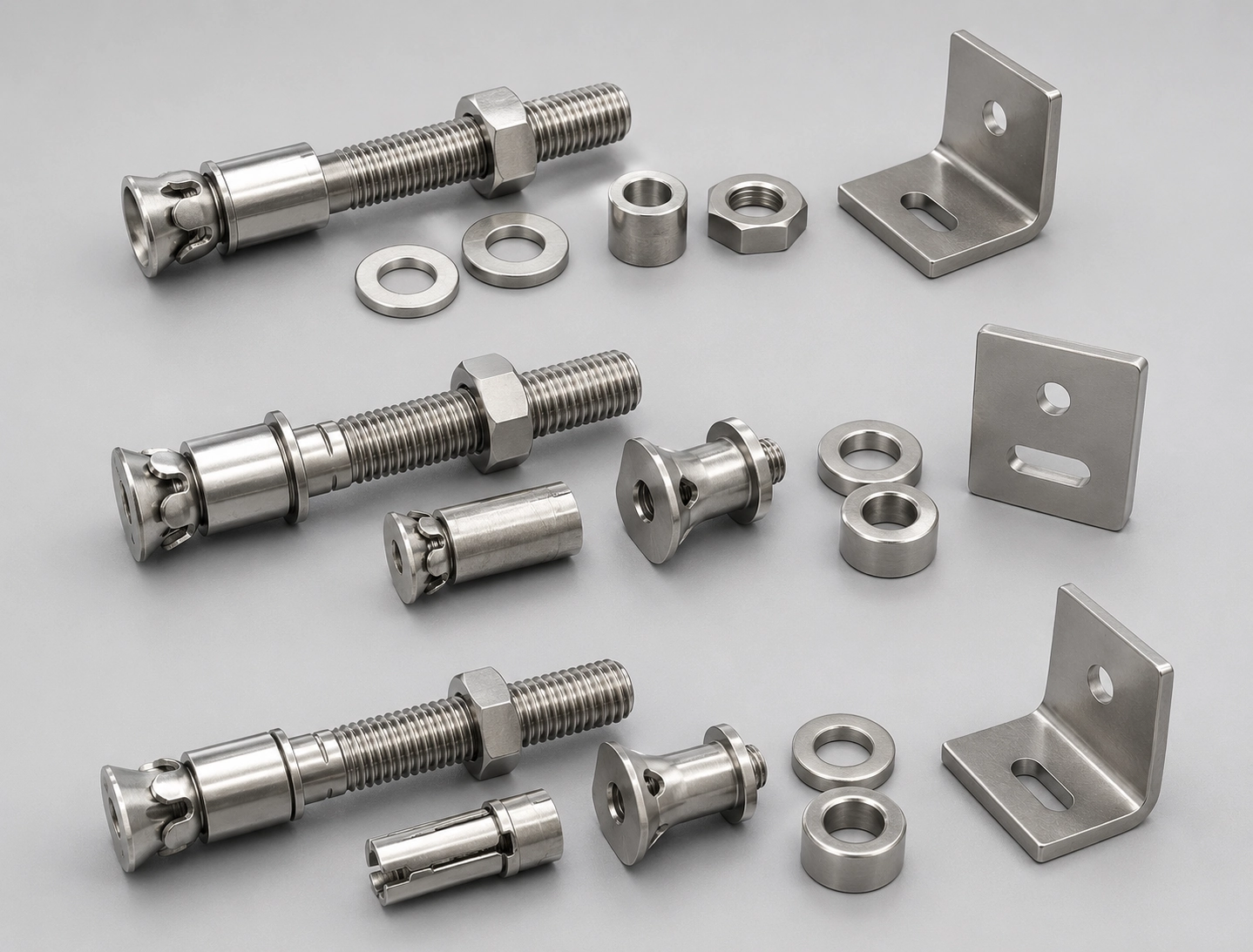
Sleeve, Cone or Engagement Configuration
Depending on the selected anchor configuration, a threaded anchor or back-bolt element may work with a sleeve, cone or engagement component inside a prepared rear undercut hole.
T-Head or Back-Bolt Configuration
A T-head, plate-head or other back-bolt arrangement may be reviewed as a drawing-defined rear fixing option when the selected drawing confirms the geometry.
Threaded Anchor and Matched Hardware
Thread system, nut, washer, spacer and bracket interface should be stated so the fastened assembly can be reviewed according to the purchase specification.
Custom Configuration According to Drawing
Drawing-defined anchor geometry may be reviewed when the drawing states material, dimensions, tolerances, interface and quantity requirements.

Stone and hole inputs
Stone Panel and Undercut Hole Inputs
Stone suitability cannot be confirmed from stone name alone. The RFQ should identify the stone-panel geometry, rear undercut hole details and project drawing basis so the selected anchor configuration can be reviewed.
No numeric geometry value should be assumed without the selected product specification or project drawing.
Panel Inputs
- Stone type and project-specified panel material where supported by the selected product specification.
- Stone-panel thickness, panel dimensions and installation orientation.
- Anchor quantity per panel, anchor location, spacing and edge distance.
Hole Geometry Inputs
- Cylindrical drill-hole diameter where applicable.
- Undercut diameter or undercut profile where applicable.
- Total hole depth and engagement or embedment depth.
Clearance and Drawing Inputs
- Remaining wall thickness or residual front-face thickness where applicable.
- Rear cavity, bracket clearance and interface stack-up.
- Project drawing, installation orientation and any project-specific review notes.
Material and finish review
Material and Finish Options
Rear undercut stone anchor components are commonly discussed as stainless steel hardware, with grade and finish selected according to project requirements and the selected product configuration.
Stainless Steel 304
Stainless steel 304 may be reviewed where the selected anchor configuration, exposure and purchase specification support its use.
Stainless Steel 316
Stainless steel 316 may be reviewed for projects that specify it, subject to component feasibility, finish and environmental exposure review.
Other Project-Specified Grades
Other project-specified stainless grades may be discussed as feasibility-review items when the drawing or purchase specification requires them.
Material availability should be confirmed before quotation. Final grade and finish should follow the purchase specification, selected anchor configuration and environmental exposure.
Dimensions and setting details
Dimensions, Threads and Setting Details
Dimensions, thread and setting details should follow the selected product configuration, product drawing and project documents. The RFQ should state the required interface clearly instead of relying on a generic model list.
| RFQ Input | What to State |
|---|---|
| Anchor type | State the selected rear undercut anchor, back-bolt or drawing-defined configuration. |
| Body and thread details | Provide body diameter, overall length, thread system, thread diameter and thread length where specified by drawing. |
| Hardware stack | List nut type, washer dimensions, spacer dimensions and bracket clamping or interface detail. |
| Setting interface | State setting-tool requirement, setting interface and product-specific review needs from the product specification or project documents. |
Installation coordination
Installation and Tool-Interface Review
This section supports RFQ input and coordination. It is not a universal installation manual. Installation method depends on the selected anchor configuration. Hole geometry, setting tool and procedure should follow the selected product specification and project requirements.
- Rear-hole preparation and product-specific undercut preparation should be confirmed from the product specification or project drawing.
- Cleaning requirement, anchor insertion and product-specific engagement or setting should be reviewed where stated in project documents.
- Position inspection, bracket or rail attachment and installation drawing requirements should be shared for quotation review.


Interface coordination
Bracket and Rail Coordination
Rear undercut anchors may interface with stone brackets, support rails, aluminum clips or connectors where specified, washer and spacer stack-ups, slotted bracket interfaces and custom connection plates. One anchor configuration should not be assumed to fit every bracket or rail interface.
Application context
Application and Service Context
Rear undercut stone anchors may be reviewed for concealed rear-fixed natural stone panels, ventilated stone facades, exterior stone cladding where specified, interior stone wall panels, calibrated stone-panel assemblies and custom facade panel assemblies.
Concealed Rear-Fixed Panels
Review should consider stone properties, panel geometry, anchor layout, selected anchor configuration and interface hardware.
Facade and Wall Cladding
Exterior or interior cladding context should be stated with environmental exposure, project drawings and applicable specification requirements.
Custom Panel Assemblies
Reveal details, return details and custom connector requirements should be supplied where they are shown in project drawings.
Drawing-based review
Custom Rear Undercut Anchors According to Drawing
Custom rear undercut anchor components may include custom anchor body geometry, custom back-bolt forms, special head or plate details, non-standard thread, custom sleeve or engagement component, spacer, washer, bracket interface and tool interface.
Manufacturing feasibility should be reviewed according to the drawing, material, dimensions, tolerances, quantity and process requirements.

Documents and inspection
Documentation, Inspection and Testing Requirements
Material documents, dimensional inspection and project-specific testing requirements may be discussed. Document and test availability should be confirmed before quotation.
Document Review
Buyer-requested material documents, drawing review, finish confirmation, marking and packing identification documents should be listed before quotation.
Inspection Requests
Dimensional inspection, anchor component inspection, sample or mock-up requests and third-party inspection requests may be discussed when specified.
Project-Specific Testing
Pull-out or shear test requirements may be reviewed where separately specified by the buyer or project documents. Document, inspection and project-specific testing availability should be confirmed before quotation.
Quotation preparation
RFQ Checklist
Use the checklist below to prepare a rear undercut stone anchor inquiry. A drawing is strongly recommended for any non-standard anchor, bracket interface, stone-panel layout or hole geometry requirement.

| RFQ Item | Details to Provide |
|---|---|
| Anchor type / configuration | State rear undercut anchor, back-bolt or drawing-defined configuration. |
| Stone type | Provide natural stone type or project-specified panel material where supported by the selected specification. |
| Stone-panel thickness | State the panel thickness from the project drawing or purchase requirement. |
| Panel dimensions | Provide panel length, width and relevant layout notes. |
| Anchor quantity per panel | State quantity per panel and total project quantity. |
| Anchor location and spacing | Provide anchor layout, spacing and location references from drawings. |
| Edge distance | State required edge distance or drawing-controlled location. |
| Cylindrical drill-hole diameter where applicable | Provide the selected product or drawing requirement without assuming a default value. |
| Undercut diameter / profile where applicable | State the specified undercut profile requirement from the product specification or project drawings. |
| Total hole depth | Provide total hole depth where defined by the product specification or drawing. |
| Engagement / embedment depth | State the engagement or embedment requirement where specified. |
| Remaining wall thickness | Provide residual front-face thickness where applicable to the selected configuration. |
| Anchor dimensions | List body geometry, overall length, head detail and related dimensional inputs. |
| Material grade | State stainless steel 304, stainless steel 316 or another project-specified grade for review. |
| Thread | Provide thread system, thread diameter and thread length where applicable. |
| Nut / washer / spacer requirements | List matched hardware, spacer stack-up and interface needs. |
| Bracket / rail interface | Provide bracket, rail, connector, slot or clearance details from drawings. |
| Setting-tool or installation input | State tool-interface or installation input requirements from the product specification or project drawings. |
| Surface finish | State mill finish, cleaning, passivation or project-specified finish requirement. |
| Quantity | Provide order quantity, sample needs and packing unit preference where relevant. |
| Drawing | Attach product drawing, stone-panel layout or assembly drawing for review. |
| Inspection and document requirements | List material documents, dimensional inspection and project-specific testing requests. |
| Project environment | State interior or exterior use, exposure and other project context. |
| Destination and packing notes where relevant | Provide destination and packing identification notes if they affect quotation preparation. |
Buyer questions
Rear Undercut Stone Anchors FAQ
What information is needed for a rear undercut stone anchor RFQ?
Provide anchor configuration, stone type, panel thickness, panel dimensions, anchor layout, hole and undercut inputs, material grade, thread, bracket interface, quantity, drawings and document requirements.
Are rear undercut anchors the same as general stone anchors?
No. This page focuses on concealed rear-face anchor hardware and back-bolt style configurations. General stone cladding anchors, bolts and washers are covered separately.
What stone-panel and undercut-hole details should be provided?
State stone type, panel thickness, panel dimensions, anchor location, spacing, edge distance, cylindrical drill-hole diameter where applicable, undercut profile where applicable, total hole depth, engagement depth and remaining wall thickness where applicable.
Can rear undercut anchors be coordinated with brackets or rails?
Yes, bracket, rail, washer, spacer and connector interfaces can be reviewed when the project drawing shows how the rear anchor connects to the larger fixing assembly.
Can custom rear undercut anchor components be reviewed according to drawing?
Custom anchor bodies, back-bolts, special heads, threads, spacers, washers and bracket interfaces may be reviewed according to drawing, material, dimensions, tolerance, quantity and process requirements.
Can documentation, inspection or project-specific testing be discussed?
Yes. Material documents, dimensional inspection and project-specific testing requirements may be discussed, and availability should be confirmed before quotation.
Final inquiry
Send Rear Undercut Stone Anchor Details for Review
Share drawings, stone-panel data, selected anchor configuration, material and finish requirements, bracket or rail interface details, quantities and document requests. WISINE can review the inquiry for rear undercut stone anchors and related back-bolt fixing hardware.